
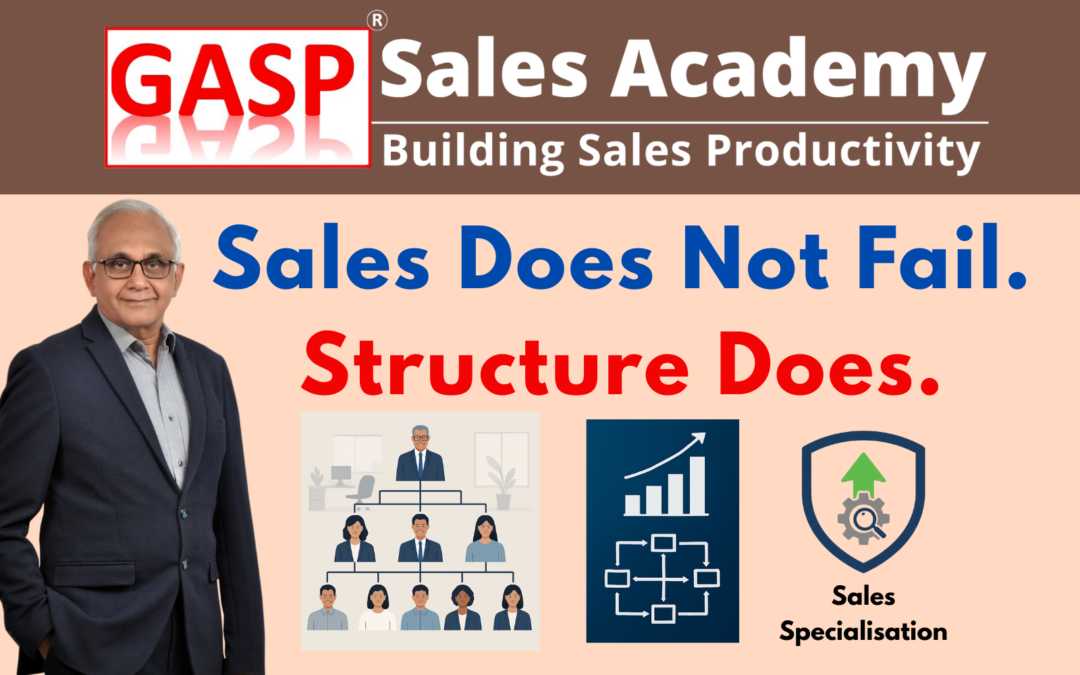
Why Sales Performance Is Designed Long Before Targets Are Set
Most SMEs do not have a sales problem. They have a structure problem.
The uncomfortable truth most founders avoid
Most founders and CEOs spend enormous time discussing targets, incentives, pipelines, and quarterly numbers. Very little time is spent designing the sales organization itself, and this is where the real problem begins.
Sales underperformance is rarely a motivation issue and almost never a talent issue. In most SMEs, it is a structural issue. Roles are loosely defined, processes lack clear ownership, handoffs are informal, and performance reviews are inconsistent. These design gaps determine whether sales execution becomes predictable or remains fragile.
When structure is weak, even strong people struggle. When structure is right, average teams deliver consistent outcomes.
Where sales organisations begin to break as SMEs grow
In early stage SMEs, multi tasking is the correct operating model. Speed matters more than elegance, and resource constraints make role overlap unavoidable.
At this stage, a single salesperson typically generates leads, qualifies prospects, conducts demos, negotiates terms, closes deals, and supports collections. This model works in the beginning and should not be criticised.
The problem starts when this structure does not evolve as the business grows. As revenue increases, product lines expand, geographies multiply, and deal cycles lengthen, the same multi tasking model begins to break. Lead quality deteriorates, follow ups slip, sales cycles expand, pipelines lose credibility, and founders gradually become bottlenecks.
Multi tasking is a growth stage. Specialisation is a scaling strategy.
Organisation design remains people first instead of process first
When sales numbers start slipping, most founders respond in predictable ways. They hire more salespeople, increase targets, add incentives, and apply pressure on teams.
These actions address symptoms rather than causes. The more fundamental question is rarely asked: what are the sales processes that must run daily for revenue to happen?
Without process clarity, hiring decisions become random, performance reviews turn subjective, attrition rises, and results remain unpredictable. People scale only when processes scale first.
Inside Sales and Field Sales are not separated at the right time
Many growing SMEs continue with a single generic sales role long after complexity demands separation. There is no distinction between velocity driven work and closure driven work.
As deal sizes grow and sales cycles lengthen, field sales teams end up spending time on weak or unqualified leads. Sales cycles stretch unnecessarily, and the cost of sale increases. This is not a headcount problem. It is a timing failure in sales organization design.
Sales roles exist without ownership clarity
In many SMEs, no one clearly owns lead qualification, opportunity validation, pipeline movement, or closure standards. Responsibilities are assumed rather than assigned.
The result is predictable. Founders firefight daily. Managers manage emotions instead of performance. Teams manage excuses instead of outcomes. When ownership is unclear, accountability cannot exist.
Performance is managed only through revenue
Most SMEs review sales performance almost entirely through revenue numbers. At the same time, daily activities, conversion ratios, funnel health, and sales cycle discipline are largely ignored.
Revenue is a result, not a controllable input. What founders can actually control are the actions and behaviors that drive revenue. When only revenue is reviewed, shortcuts increase, discounting becomes habitual, and pipeline integrity collapses.
What a correctly evolving sales organisation looks like
A well designed sales organisation is built deliberately, not intuitively. Sales stages are clearly defined, entry and exit criteria are explicit, ownership is unambiguous, and metrics focus on leading indicators rather than outcomes alone.
Roles evolve in line with growth. Marketing focuses on lead generation, Inside Sales owns qualification and early engagement, Field Sales owns opportunity progression and closure, and Sales Operations enforces review discipline. Not all roles need to be hired on day one, but all roles must exist on paper.
Sales reviews are driven by data, not opinions. Variances are discussed objectively, root causes are identified, and corrective actions are tracked.
As the organisation matures, the founder transitions from being the best salesperson to being the architect of the sales engine. Growth demands structure, not heroics.
The bottom line
Sales problems are rarely solved by pushing harder. They are solved by designing better.
Sales is not an art dependent on individual brilliance. It is a science driven by structure, process, and disciplined execution. When structure evolves in step with the business, performance follows naturally.
Call to Action
If your sales outcomes feel unpredictable despite effort, do not push harder. Fix the structure.
At GASP Sales Academy, we help founders and CEOs redesign sales organizations using Generally Accepted Sales Principles so that execution becomes repeatable, measurable, and scalable.
Connect with us or visit our website : www.gaspsalesacademy.com for more details
Sales growth does not start with targets. It starts with structure that evolves.
#SalesPerformance #SalesExecution #SalesStrategy #BusinessGrowth #ScalingBusiness #SMEIndia #MSMEIndia #GrowingSMEs #IndianSMEs #ProcessDriven #BusinessSystems #SalesArchitecture #OperationalExcellence
